




















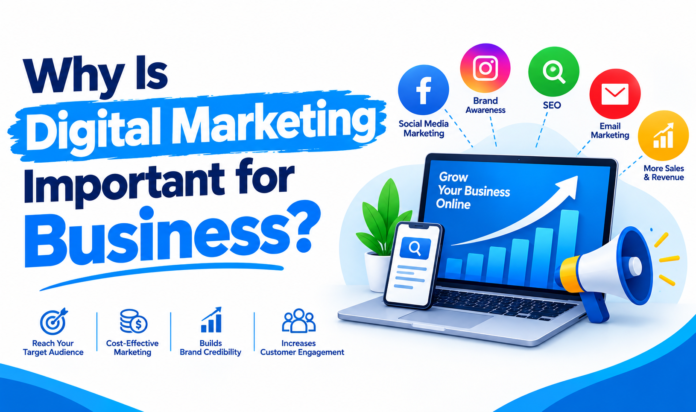
In today’s connected world, customers increasingly use the internet to discover businesses, compare products, read reviews, and make purchasing decisions. Whether a business is small, medium-sized, or a large company, having a strong digital presence has become an important part of reaching potential customers. Digital marketing uses online channels such as search engines, social media, websites, email, online advertising, and content platforms to promote products and services.
But why is digital marketing so important for business?
1. Reach More Potential Customers
Traditional marketing is often limited by geography and distribution. Digital marketing allows businesses to reach potential customers across cities, countries, and even international markets.
A well-optimized website can attract visitors from search engines, while social media and online advertising can introduce a business to new audiences.
For businesses that want to expand beyond their local market, digital marketing can provide an important channel for reaching new customers.
2. Build a Strong Online Presence
Before contacting a business, many customers search for information online.
They may look for:
- The company’s website
- Facebook or other social media pages
- Customer reviews
- Product information
- Prices and offers
- Contact details
- Business location
A professional online presence can make it easier for potential customers to find and understand a business.
3. Generate More Leads
Digital marketing can help businesses generate potential customer inquiries, commonly known as leads.
For example, a business can use:
- Google Search campaigns
- Social media advertising
- Landing pages
- Contact forms
- Messenger or WhatsApp
- Email marketing
- Content marketing
These channels can encourage interested visitors to contact the company or request additional information.
4. Reach the Right Audience
One major advantage of digital advertising is audience targeting.
Depending on the platform and campaign, businesses may be able to target audiences based on factors such as:
- Location
- Age range
- Interests
- Search behavior
- Previous website activity
- Customer segments
This can help businesses present relevant messages to people who are more likely to be interested in their products or services.
5. Cost Control
Digital marketing offers businesses different budget options.
A small business can start with a relatively limited advertising budget and increase spending as it gathers data and evaluates campaign performance.
Businesses can also choose different marketing approaches, including:
SEO → Content Marketing → Social Media → Email Marketing → Paid Advertising
Not every business needs to use every channel. The right combination depends on the company’s objectives, target market, and available resources.
6. Measure Marketing Performance
One of the biggest advantages of digital marketing is the ability to measure many aspects of a campaign.
Businesses can monitor metrics such as:
- Website visitors
- Page views
- Clicks
- Leads
- Conversion rates
- Advertising costs
- Customer acquisition costs
- Sales generated from campaigns
This data can help businesses understand which marketing activities are producing useful results and where improvements may be necessary.
7. Improve Customer Engagement
Digital marketing is not only about advertising.
Businesses can use social media, email, websites, messaging platforms, and online communities to communicate directly with customers.
Regular communication can help businesses:
- Answer questions
- Share product updates
- Publish educational content
- Collect feedback
- Address customer concerns
- Build long-term relationships
Good customer communication can be an important part of building trust.
8. Improve Brand Awareness
A business needs to be visible before customers can consider buying from it.
Consistent digital content can help people become familiar with a company’s:
- Brand name
- Products
- Services
- Expertise
- Values
- Unique selling points
For example, publishing useful articles and videos can help a company demonstrate knowledge within its industry while increasing its visibility online.
9. Support Local Businesses
Digital marketing is not only for international companies.
A local restaurant, retailer, real-estate company, insurance agency, bank, educational institution, or service provider can use digital marketing to reach customers in its own area.
Local SEO, Google Business Profile, social media, online reviews, and location-based advertising can help businesses become easier to discover.
10. Increase Website Traffic Through SEO
Search Engine Optimization, or SEO, is one of the most important components of digital marketing.
SEO helps businesses improve the visibility of their websites in search-engine results.
Useful SEO activities can include:
- Keyword research
- High-quality content
- Technical SEO
- Mobile optimization
- Internal linking
- Page-speed improvements
- Local SEO
- Image optimization
- Building reputable backlinks
SEO generally takes time and does not guarantee a particular ranking, but a well-maintained website can become an important long-term marketing asset.
11. Compete With Larger Businesses
Digital marketing can provide smaller businesses with opportunities to compete for online attention.
A small company may not have the advertising budget of a multinational corporation, but it can focus on a specific niche, local market, customer group, or specialized service.
Strong content, useful information, good customer service, and a well-optimized website can help smaller businesses establish an online presence.
12. Build Long-Term Business Value
Paid advertising can produce immediate visibility, but businesses can also invest in digital assets that continue providing value over time.
These assets may include:
- A professional website
- Search-engine visibility
- Email subscriber lists
- Educational content
- Social media communities
- Customer reviews
- Brand recognition
- Useful videos and resources
Building these assets can help create a sustainable digital presence.
Digital Marketing Is More Than Social Media
Many people associate digital marketing primarily with Facebook or Instagram advertising. In reality, digital marketing includes a much broader range of activities.
A complete strategy may include:
Website + SEO + Content + Social Media + Email + Paid Advertising + Analytics
The right strategy depends on the business.
A B2B company may focus heavily on search, LinkedIn, email, and industry content. A local business may prioritize local SEO and social media. An online store may combine SEO, paid advertising, email marketing, and product content.
How to Start Digital Marketing
Businesses do not necessarily need to launch every marketing channel at once.
A practical starting process is:
Step 1: Define Your Target Customer
Understand who you want to reach and what problem your product or service solves.
Step 2: Build or Improve Your Website
Make sure customers can easily understand what you offer and how to contact or purchase from you.
Step 3: Create Useful Content
Publish information that answers customers’ questions and demonstrates your expertise.
Step 4: Focus on SEO
Optimize important pages so potential customers can discover your business through search engines.
Step 5: Use Social Media Strategically
Choose the platforms where your target audience is actually active.
Step 6: Test Paid Advertising
Start with a controlled budget and measure results before increasing spending.
Step 7: Analyze the Data
Track traffic, leads, conversions, and costs to understand what is working.
Final Thoughts
Digital marketing has become an important part of modern business because customers increasingly research and communicate online.
It can help businesses increase visibility, reach new audiences, generate leads, communicate with customers, build brand awareness, and measure marketing performance.
However, digital marketing is not a guaranteed shortcut to business success. Results depend on factors such as the product or service, competition, target audience, marketing strategy, content quality, budget, execution, and customer experience.
The most effective approach is to treat digital marketing as a long-term business investment rather than simply an advertising expense.